
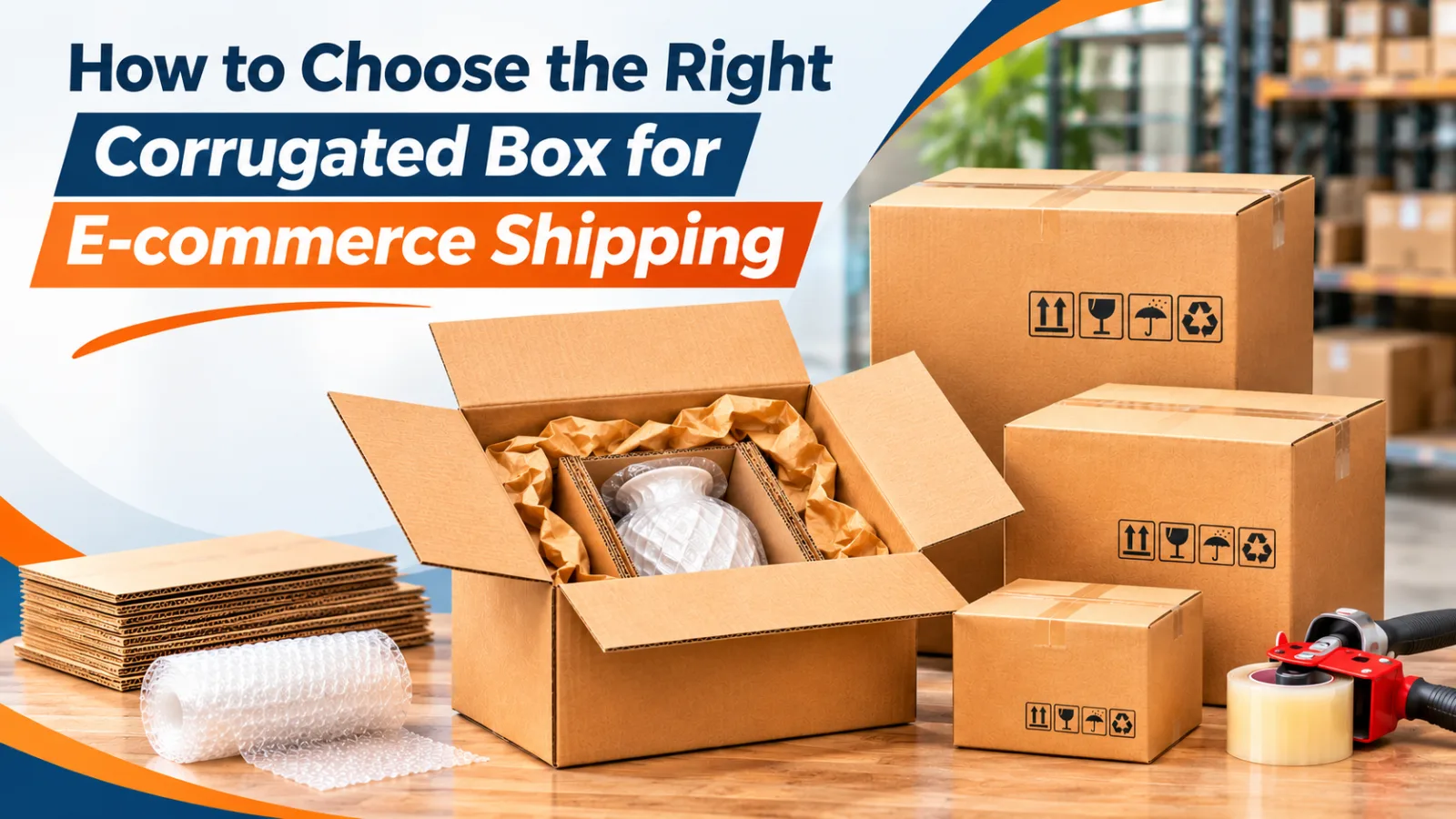
Imagine a customer ordering a product online and receiving it with damaged packaging or a broken item. Even if the product was of good quality, poor packaging can create a negative impression of the business.
For e-commerce businesses, packaging is more than just a box. It protects products during transportation, supports safe handling, and helps create a positive customer experience.
Choosing the right corrugated box for e-commerce shipping is therefore an important part of order fulfilment. The box should provide sufficient protection, fit the product properly, and remain cost-effective for the business.
In this guide, we will explore the important factors to consider when selecting corrugated boxes for online product deliveries.
1. Understand the Product You Want to Ship
The first step is to understand the product that will be packed inside the box.
Different products require different packaging solutions. A lightweight clothing item does not need the same box strength as a heavy electronic product or fragile glass item.
Before selecting a box, consider:
Product weight.
Product dimensions.
Shape and design.
Fragility.
Sensitivity to moisture.
Storage and transportation requirements.
For example, clothing and soft furnishings may require relatively lightweight packaging, while electronics, glassware, and machinery components may need stronger boxes and additional protective materials.
Understanding the product helps you select suitable box specifications.
2. Choose the Correct Corrugated Box Size
Box dimensions play an important role in e-commerce shipping.
A box that is too small may put pressure on the product, while an oversized box can allow unnecessary movement during transportation.
Both situations can increase the possibility of product damage.
Consider the following points when selecting box dimensions:
Measure the Product Properly
Measure the length, width, and height of the product before selecting the box.
Remember to include additional space for protective packaging materials such as bubble wrap, foam, or paper cushioning.
Avoid Excessive Empty Space
An oversized box may require additional filling material and increase packaging consumption.
It can also increase shipping costs when courier charges are calculated using volumetric weight.
Allow Suitable Cushioning Space
The product should fit comfortably inside the box with sufficient room for protective materials.
The required clearance depends on the product's fragility, weight, and shipping conditions.
3. Understand Different Corrugated Box Flute Types
The flute structure is an important factor when selecting corrugated packaging.
Flutes are the wavy paper layers between the liner sheets of corrugated board. They contribute to cushioning, stacking strength, and overall box performance.
Common flute types include:
A-Flute
A-flute has a relatively large flute profile and provides cushioning properties. It can be considered for products that require additional cushioning, depending on the overall board construction.
B-Flute
B-flute has a smaller profile and offers good resistance to crushing. It is commonly used for packaging applications that require a relatively compact board structure.
C-Flute
C-flute provides a balance of cushioning and stacking performance. It is widely used in general shipping and transportation packaging.
E-Flute
E-flute has a thinner profile and provides a smoother surface for printing. It is suitable for various retail and lightweight packaging applications.
F-Flute
F-flute is thinner than several commonly used flute types and is used in compact packaging applications where space and appearance are important.
The correct flute should be selected according to product weight, protection requirements, box dimensions, and transportation conditions.
4. Select the Right Number of Corrugated Walls
Corrugated boxes are available in different wall constructions. The number of walls affects the overall strength and protective performance of the packaging.
Single Wall Corrugated Boxes
Single wall boxes consist of one corrugated medium between two liner sheets.
They are commonly used for lightweight and medium-weight products, depending on the board specifications.
Double Wall Corrugated Boxes
Double wall boxes contain two corrugated mediums and three liner sheets.
They provide additional strength and are suitable for many heavier products and shipping applications.
Triple Wall Corrugated Boxes
Triple wall boxes contain three corrugated mediums and four liner sheets.
They are designed for demanding packaging applications where greater structural strength may be required.
The correct construction should be selected after considering the product's weight, stacking requirements, and expected handling conditions.
5. Consider Product Protection and Cushioning
A corrugated box provides structural protection, but some products also need additional cushioning inside the package.
This is particularly important for fragile and sensitive items.
Common protective materials include:
Bubble wrap.
Foam sheets.
Corrugated partitions.
Paper cushioning.
Protective inserts.
Cardboard dividers.
For example, glass products may require individual wrapping and internal separation to prevent direct contact during transportation.
Electronic products may need cushioning to reduce the impact of shocks and vibrations.
The packaging should prevent unnecessary product movement without applying excessive pressure to the item.
6. Evaluate Box Strength and Quality
A corrugated box should be strong enough to handle the expected weight, stacking, and transportation conditions.
Businesses should consider important packaging quality parameters before selecting a supplier.
Edge Crush Test (ECT)
Edge Crush Test measures the ability of corrugated board to resist compression when pressure is applied to its edge.
It is an important parameter for evaluating the board's stacking-related strength.
Box Compression Test (BCT)
Box Compression Test measures the compressive strength of a completed box.
It helps evaluate how well the box can withstand vertical compression under specified testing conditions.
Bursting Strength
Bursting strength measures the resistance of paper or corrugated board to bursting pressure.
It can help assess the board's resistance to certain forms of physical stress.
These tests provide useful information about packaging performance. The appropriate specifications should be determined according to the product and shipping requirements.
7. Consider Shipping and Handling Conditions
E-commerce packages may pass through several stages before reaching customers.
They can be handled by warehouse staff, sorting centres, courier personnel, and delivery partners.
During transportation, boxes may experience:
Repeated handling.
Stacking pressure.
Vibrations.
Accidental impacts.
Exposure to moisture.
Long-distance transportation conditions.
If products are shipped over long distances, packaging should be selected according to the expected transportation environment.
For fragile products, additional cushioning and internal partitions may help reduce the risk of damage.
8. Choose Packaging That Controls Shipping Costs
Packaging costs can directly influence the overall cost of e-commerce order fulfilment.
A suitable corrugated box should provide sufficient protection without using unnecessary material.
Consider these factors:
Box Weight
Heavier packaging can increase the overall shipment weight.
Selecting an appropriate board specification can help avoid unnecessary packaging weight.
Volumetric Weight
Courier companies may calculate shipping charges using actual weight or volumetric weight, depending on their pricing rules.
Oversized packaging can increase volumetric weight even when the product itself is lightweight.
Material Consumption
Using the correct box dimensions helps reduce excess cardboard and additional cushioning requirements.
Product Damage Costs
Weak packaging may lead to damaged products, customer complaints, replacements, and returns.
Businesses should evaluate total packaging costs rather than focusing only on the price of an individual box.
9. Consider Custom Printed Corrugated Boxes
Packaging also contributes to brand recognition.
Custom printed corrugated boxes allow businesses to display their brand name, logo, product information, and handling instructions.
For e-commerce businesses, branded packaging can make deliveries look more professional.
Common printing elements include:
Company logo.
Brand name.
Product identification.
Handling symbols.
Fragile product instructions.
Shipping-related information.
Printing requirements should be discussed with the packaging manufacturer to determine the suitable printing method and board surface.
10. Choose a Reliable Corrugated Box Manufacturer
The quality of packaging depends not only on the specifications but also on the consistency of manufacturing.
A reliable manufacturer should understand your product requirements and recommend suitable packaging options.
Before finalising a supplier, consider:
Manufacturing quality.
Availability of different box sizes.
Board specifications.
Customisation options.
Printing capabilities.
Production capacity.
Delivery timelines.
Consistency across repeat orders.
It is also useful to request samples and conduct packaging trials before placing large-volume orders.
Common Mistakes to Avoid When Choosing E-commerce Packaging
Businesses should avoid these common packaging mistakes:
Selecting boxes without measuring products.
Using weak boxes for heavy products.
Ignoring flute and wall construction.
Leaving excessive empty space inside the box.
Not using sufficient cushioning for fragile products.
Ignoring stacking and transportation conditions.
Choosing packaging only on the basis of price.
Not testing packaging before bulk production.
Avoiding these mistakes can help businesses improve packaging efficiency and reduce preventable shipping damage.
Frequently Asked Questions
Which corrugated box is best for e-commerce shipping?
The best box depends on product weight, dimensions, fragility, and shipping conditions. Single wall boxes may suit many lightweight products, while heavier or more demanding applications may require double wall or triple wall construction.
Why is box size important in e-commerce packaging?
The correct box size helps reduce unnecessary movement, protects products, limits excess packaging material, and can help control volumetric shipping costs.
Which flute type is suitable for e-commerce boxes?
C-flute is commonly used for general shipping applications. B-flute and E-flute may be suitable for other requirements. The final selection depends on board specifications, product weight, and protection needs.
Are double wall corrugated boxes better for heavy products?
Double wall boxes generally provide greater structural strength than comparable single wall constructions. However, the correct box should be selected based on actual load, dimensions, stacking requirements, and testing.
How can businesses reduce damage during e-commerce shipping?
Businesses can use correctly sized boxes, suitable board strength, appropriate internal cushioning, and proper sealing methods. Packaging trials can help identify weaknesses before regular shipping.
Can corrugated boxes be customised for e-commerce businesses?
Yes. Corrugated boxes can be customised according to product dimensions, board construction, printing requirements, and packaging needs.
Conclusion
Choosing the right corrugated box for e-commerce shipping requires careful consideration of product dimensions, weight, flute type, board construction, cushioning, and transportation conditions.
A properly selected box can help protect products, improve packaging efficiency, and support a better delivery experience.
For e-commerce businesses, investing in suitable corrugated packaging is an important step towards reliable order fulfilment and customer satisfaction.
Explore corrugated packaging solutions and packaging information through Nirmal Packaging.

Nirmal Packaging Industries
Est. 2011 • C-192, Sec-10, Noida — Manufacturer of corrugated boxes & industrial packaging solutions.